
Your Price Was Never Decided. It Just Happened.
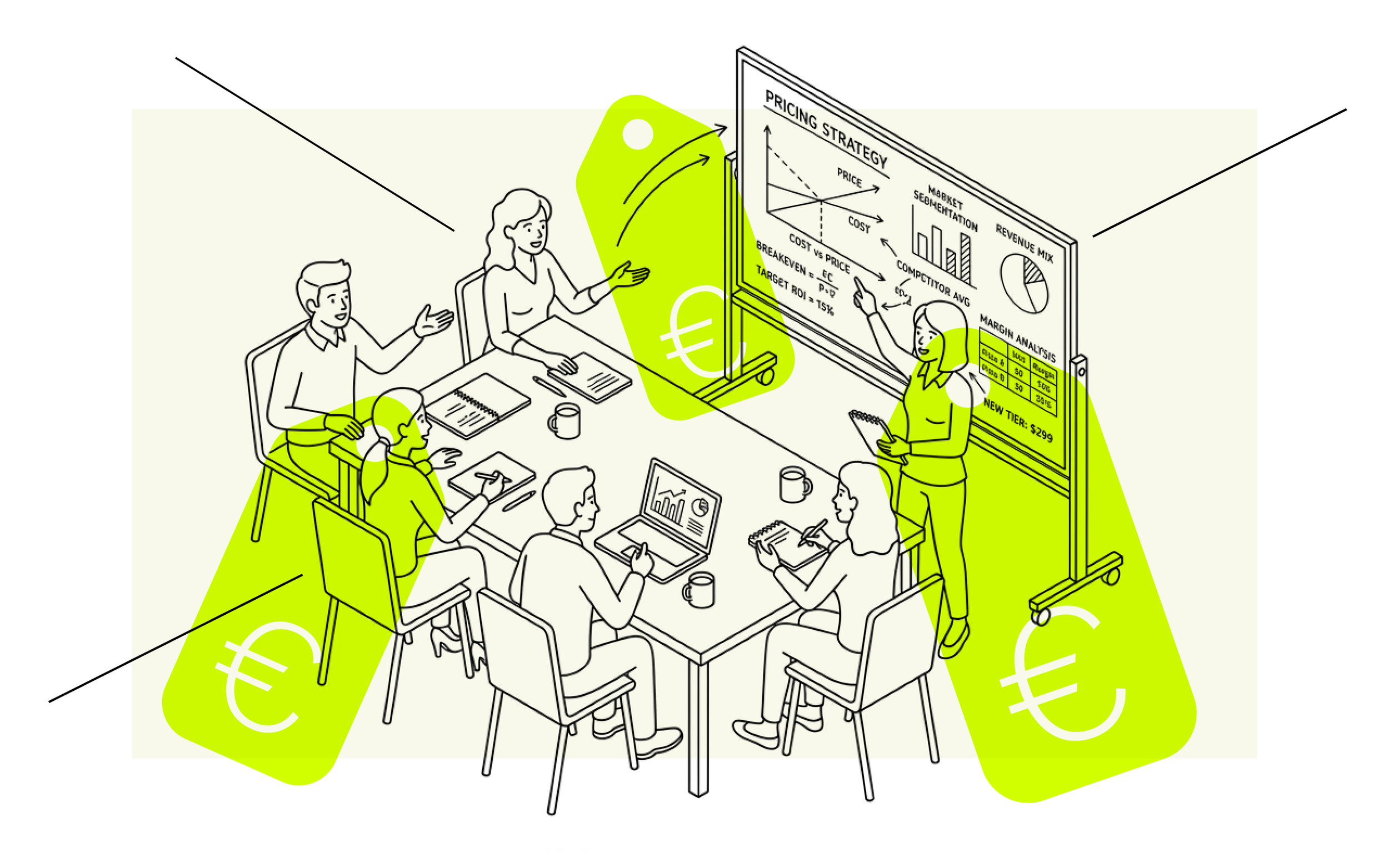
Across industries, most companies have never actually tested whether their price is right. A global survey of more than 1,700 B2B companies found 85% believe their own pricing decisions could improve, and only a quarter use any dedicated tool to manage it [1]. Multiply that across a decade of growth and you get companies charging two customers 40% apart for the same thing, unable to say why. Most conversations about pricing focus on the number itself — what to charge, how to raise it, how to defend it in a negotiation — rather than on why that number came to exist in the first place.
Why Do We Price The Way We Do?
There are perfectly good reasons a price changes: costs rise, a market matures, a competitor forces your hand. But most first prices aren't set for any of these reasons. They're set because a decision had to be made quickly — a number was needed for the first sales call, so a competitor's list price got copied, rounded to something that felt fair, and used. Nobody expected it to still be the price a year later, let alone five.
Pricing gets designed the way a wardrobe gets filled under pressure: fast, situational, rarely revisited once it's in place. And just as a closet fills with pieces nobody meant to keep wearing, a pricing model fills with numbers nobody meant to keep charging.
Left unexamined, that kind of pricing doesn’t stay quiet forever. Cost increases and market pressure will always find their way into the number, and customers will absorb them for a while. But a price nobody can explain has a shorter shelf life than one that’s actually understood — sooner or later, those customers stop asking why and just leave.
“It’s Just What We Charge.”
It's probably the most common answer founders give when asked how they arrived at their price.
Interestingly, it's rarely said by companies with one product and a handful of customers. More often, it comes from companies with a hundred contracts already signed — each negotiated a little differently, each a small compromise nobody wrote down as policy. The problem isn't that prices vary. The problem is nobody can explain why they vary if asked.
We've watched this at both ends. A German cleantech start-up already had genuine instincts about its own pricing — the work was aligning that instinct with the go-to-market strategy at an early inflection point, not inventing one from nothing. It went on to raise €10M in seed funding and €24M in its Series A. An Irish energy company had accumulated the opposite problem: no structure, every deal negotiated from zero. A pricing model and a governance framework brought 15% less churn and 4 points of margin back within a year. One company needed its instincts structured. The other needed structure from scratch. Both got fixed the same way — someone finally looked at pricing as a whole, instead of one deal at a time.
The Weight of the First Number
Once a price exists — even an accidental one — it becomes the reference point everyone measures against. People don't tend to revisit decisions once they're made; they defend them, extend them, build around them. Economists have a name for this: status quo bias, first documented in 1988 [2] and shown since to apply with particular force to pricing [3], where complexity, time pressure, and sheer decision volume make a placeholder far more durable than anyone intended it to be.
This isn't a failure of discipline. It happens to careful, well-run companies as often as careless ones. Pricing rarely feels urgent enough to interrupt for — until a customer asks why they're paying more than the company next door, and there's no good answer ready.
Better Numbers
Being deliberate about pricing is less about charging more and more about knowing why you charge what you charge.
When a company knows what a customer actually values, it prices for that instead of guessing. When someone outside the day-to-day looks at pricing as a whole system, the one-off exceptions stop quietly compounding into a pattern nobody can explain. When finance, sales, and leadership can point to the same number for the same reason, the negotiation gets shorter, not longer.
The benefits show up quickly: fewer deals lost to confusion about value, less margin discounted away “just to be safe,” a story that holds up the next time someone — a customer, a board member, an investor — asks how the price was actually set.
Not because pricing got more complicated. Because it finally became a decision instead of an accident.
A Well-Priced Company
What if the goal wasn't simply to fix pricing once it breaks, but to make pricing something a company actually designs?
A company that knows what its customers value, prices deliberately for it, and revisits that decision on purpose rather than by accident. A company where the answer to “why do we charge this” is a sentence, not a shrug.
Because the healthiest price is not the one that never gets questioned.
It is the one you can still explain, years later — because you actually decided it.
References
1. Bain & Company, "A Survey of 1,700 Companies Reveals Common B2B Pricing Mistakes," Harvard Business Review, June 2018.
2. Samuelson, W., & Zeckhauser, R. (1988). "Status Quo Bias in Decision Making." Journal of Risk and Uncertainty, 1(1), 7–59.
3. Bergers, D. (2022). "The Status Quo Bias and Its Individual Differences from a Price Management Perspective." Journal of Retailing and Consumer Services.
